Saturday, January 9, 2016

Wild white indigo

Be quick, it sprouts in April and blooms in May, and then turn a dark brown.

Wild white indigo Sedgwick County


This member of the legume family and cousin to the blue indigo is quick grower. It flowers in May then flowers and leaves turn a dark brown. White Wild Indigo is an arching lightly-branched, smooth-stemmed herbaceous bush. Its pea-like blossoms gather in profusion on long showy spikes. This plant is popular with insects. Bumblebees are busy pollinating the flowers and caterpillars of several skippers, butterflies and moths feed on the leaves.

 A hot tea from the root was brewed as a purgative or to relieve tooth pain. Indian children would use the seed pods as rattles in imitation of ceremonial dances.

Wild white indigo Sedgwick County

Wild white indigo Sedgwick County


Saturday, November 21, 2015

Blue Hearts

This perennial flower is more purple than blue, but still it is called Blue Heart.

Blue Heart and Honey Bee


The Blue Heart is part of the Figwort Family. The scientific Genus name, Scrophularia, comes from the plant’s traditional use in Europe as a remedy for scrofula, a glandular swelling in the neck. The plants were also used to treat hemorrhoids, which were commonly called “figs”.

Ouch!

Blue Heart in bloom Greenwood County


The Kansas Blue Heart blooms for three months from June until August. The plant and flowers may appear massed in groups or as isolated stems throughout the prairie fields. Where the grass is short, the leaves and flowers remain close to the ground, but in the taller short grasses of the prairie fields the flowers will rise up to three feet to signal their presence to the bees and flies.

The flowers on the stem appear in order from the base of the stem, finally flowering at the end.

Blue Heart florets on a single stem


Time for a botany lesson.

Generally, a flower consists of four whorls, specialized rings of leaves: the calyx on the outside; the corolla lying inside the calyx; the stamens enclosed by the corolla, and the pistil in the center of the flower. The calyx consists of green sepals, separated or fused, which form a cup to protect and enclose the corolla. The corolla is the part of the flower we normally think of as pretty, made up of petals that again, like the calyx may be separated or fused. The stamens are the long tender filament we call the male reproductive element producing pollen that bees and flies pick up and transfer to other flowers. Finally, at the heart of the flower is the pistil, the female reproductive organ from which a long and slender style arises. The stigma is found at the tip of the style trapping pollen transferred by bees and flies.

a mass of Blue Heart flowers in Greenwood County


Here is how the Kansas Wildflowers describes the Blue Heart flower:

“Calyx tubular, sepals partially united, 1/4 to 1/3 inch long; … corolla with lobes spread widely at end of narrow tube, violet to purplish, 3/5 to 1 inch long, soft hairy within; lobes 5, nearly equal, oblong, 1/5 to 2/5 inch long…; stamens 4, included in tube; filaments short; … stigma entire, club-shaped.”

Monday, November 2, 2015

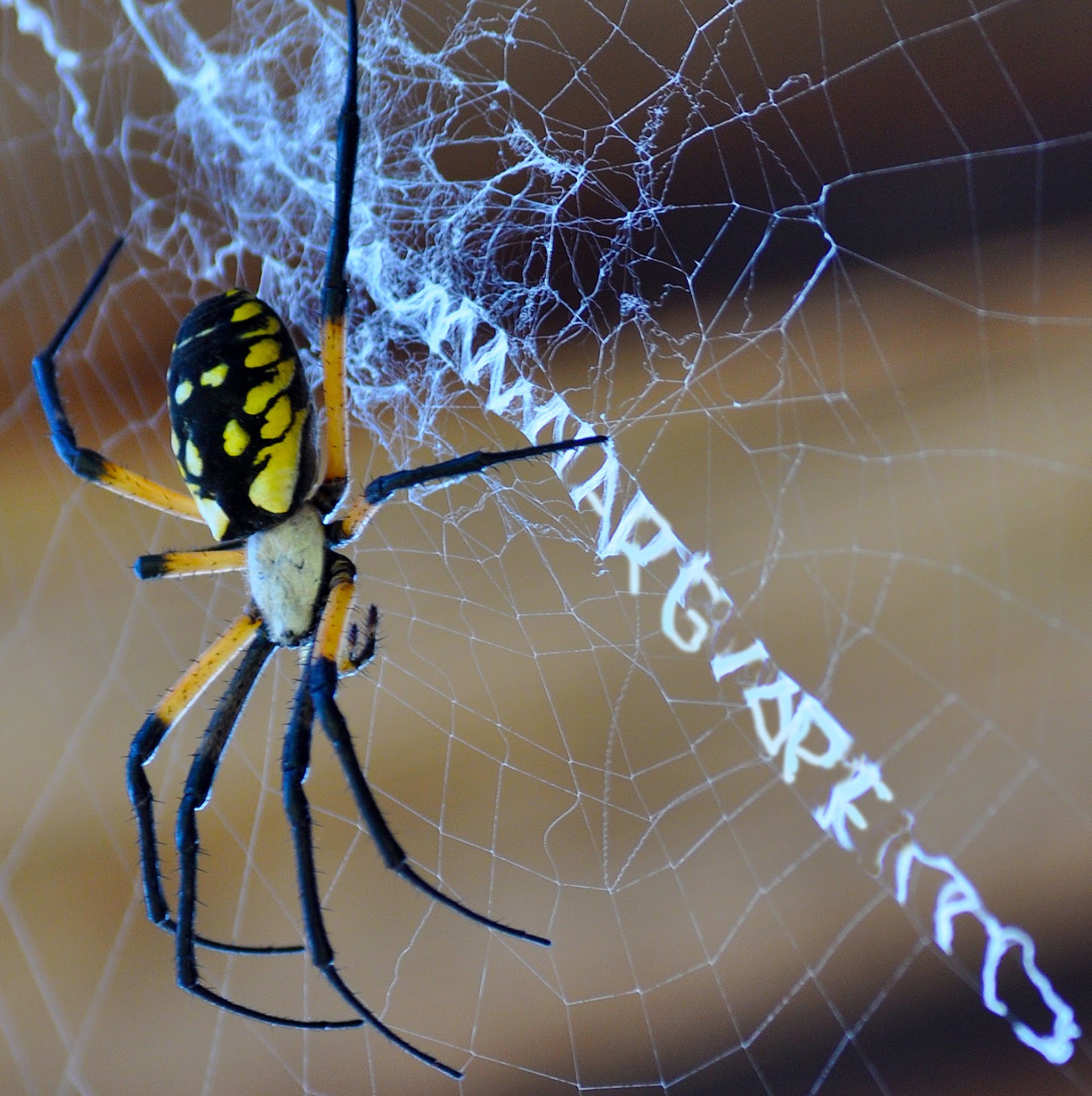
Argiope aurantia - Yellow Garden Spider

Yellow Garden Spider (Argiope aurantia) 

Little Miss Muffet sat on a tuffet eating her curds and whey when all of the sudden along came a yellow garden spider who sat down beside her and frightened Miss Muffet away. 

Yellow Garden Spider (Argiope aurantia)


The Yellow Garden Spider is common throughout Kansas in the late fall. It is fairly large by spider standards; its body can be the size of a dime when the female is full of eggs. I found this yellow and black spider under the eave of a bridge, but you are just as likely to come face to face with them in tall weeds in open fields where they stretch out their webs to catch unwary insects, such as aphids, flies, grasshoppers, wasps, and bees. 

As for Miss Muffet, the spider rarely bites unless bothered and then its bite is annoysome rather than deadly. Then too, don’t we wonder why Miss Muffet was eating her curds and whey - cottage cheese to you and me - outside in the garden where her tuffet was likely to get soiled and dirty, rather than at the kitchen table where proper young girls should be? 

Unlike our dirty Miss Muffet, the Yellow Garden Spider is very neat and orderly. In a nightly ritual, she eats the circular interior part of the web and rebuilds it each morning with fresh new silk. 

Have you figured out yet that a tuffet is another name for an ottoman?

argiope
 

Saturday, October 10, 2015

Curlycup Gumweed

The common Curlycup Gumweed, Grindelia squarrosa, grows along paths and roadsides from June through fall. 


Curlycup Gumweed


Native Americans used the Curlycup Gumweed as a wash to treat poison ivy and burns and as an ointment to manage asthma and bronchitis, and also as a common cough remedy. Cowboys used the dried flower heads as fixin’s in cigarettes to treat asthma. The gooey white leaf sap is a substitute for chewing gum. The yellow flowering heads and seed pods produce a yellow dye.  The flower blooms from August throughout the fall.

Curlycup Gumweed and friend

Sunday, September 6, 2015

From May til September

It is the first week of September in Kansas. 

Wingstem and Flesh Fly

The chiggers and horseflies are still biting. The trees are just beginning to turn yellow and red. We had more rain than we should expect this summer, and so the summer grasses are taller and greener. Grasshoppers, crickets and bees are still to be found in the fields. The sounds of nature are softer and one hears the gentle rustle of the cool wind.

Pawnee Prairie Park on the western edge of Wichita, off Kellogg and next to the airport, is a lovely place to walk with the dogs. Plumlee Trails follows Cowskin Creek (5 miles more or less with 3 loops and dozens of turn-offs, a popular trail for horses). The cool weather brings to mind William Cullen Bryant's observation, “Autumn...the year's last, loveliest smile."

Kansas wildflowers are still to be found. The Kansas Sunflower is everywhere in bloom, but so too the spiky, purple Thistle is in abundance, and Snow-on-the Mountain, with its showy white and green leaves. There are "lesser" flowers whose names are not so commonplace - the wingstem and curly cup gumweed for example.

curly cup gumweed


With my Iphone I captured a pic of a Pennsylvania leatherwing beetle camped out on the snow-on-the-mountain searching for aphids. 

Surely, Winter is not far away.


Snow-on-the-Mountain


Rod Stewart's Maggie May comes to mind:

Wake up Maggie I think I got something to say to you
It's late September and I really should be back at school
I know I keep you amused but I feel I'm being used
Oh Maggie I couldn't have tried any more
You lured me away from home just to save you from being alone
You stole my heart and that's what really hurt
snow-on-the-mountain

snow-on-the-mountain

snow-on-the-mountain
nn

Wednesday, July 22, 2015

Coreopsis

Believe it or not, the Coreopsis, aka calliopsis and tickseed, is a member of the Daisy family, Asteraceae. Its pretty yellow flower sometimes has red rays that emanate from the center. Coreopsis are used as food plants by the caterpillars of some butterflies. 

Coreopsis was designated the state wildflower of Florida.

Coreopsis in Kansas


Sunday, July 19, 2015

Why is this dragonfly called the "widow skimmer"?

widow skimmer (Libellula luctuosa), Kansas


Why is this dragonfly called the "widow skimmer"?

The widow skimmer (Libellula luctuosa) is found throughout the United States and right here in Wichita, Kansas around ponds and marshy areas.

I have looked online for explanations of its name, widow skimmer, but, pretty much, drawn a blank.

So, here goes. The Latin name is Libellula luctuosa, which translates as "water-level" and "mournful". In English, we transpose the words and come up with mournful water skimmer. Okay, the water skimmer makes sense for these insects that love to hover over marshes and lakes and grab other insects, but what about "widow"?

Here is my guess. Look at the two pairs of black stripes or bands on the wings. Long before Carl Linenaeus and modern taxonomy, women in mourning and widows wore black clothing in grief after the death of a loved one, and her grieving orphans wore a makeshift black armband.

perching widow skimmer


Makes sense, but it is only a guess.

Saturday, July 18, 2015

Milkweed Bug

Milkweed Bug

The Milkweed Bug, Oncopeltus fasciatus, is orange to orange-red and black in color, making our bug look somewhat like an escaped prison inmate.

Milkweed Bug, Sedgwick County, Kansas


Milkweed Bugs feed on the Milkweed plant. This helps to make these insects safe from predators, just like the Monarch butterfly whose larvae feed on Milkweed, as the sap in the Milkweed latex contains cardiac glycosides, a type of cardenolide, which is a heart-stopping steroid.

The Milkweed Bug is a true-bug, meaning they feed not with a mouth but with their long proboscis, which pierces and sucks on the seed pods, leaves, and stems of milkweed.

http://www.missouribotanicalgarden.org/gardens-gardening/your-garden/help-for-the-home-gardener/advice-tips-resources/pests-and-problems/insects/plant-bugs/milkweed-bugs.aspx

The sex of the insect can be determined by examining the abdomen. On the male, counting down from the thorax on the ventral side (abdomen), the fourth abdominal segment bears a black band, and on the female there are two identifiable black spots.

Abdomen of Milkweed Bug, female on the bottom has proboscis retracted


Females lay eggs ("oviposit" if you want the fancy zoological term), about 30 eggs a day or 2000 in a lifetime of approximately a month, depositing the eggs between the pods of the Milkweed plant.  In about four days (as the temperature warms to 80 degrees Fahrenheit) the nymphs hatch. The young nymphs resemble adults, but do not have wings or reproductive organs. Nymphs grow by stages called instars, each stage lasting approximately a week.

 http://www.mymonarchguide.com/2008/05/milkweed-bugs.html

Females mate 5 to 12 days after the last molt for females and males two to three days. Copulation may last up to 10 hours.

http://www.life.illinois.edu/ib/109/Insect%20rearing/milkweedbug.html


Mating Milkweed Bugs on Milkweed

Thursday, June 18, 2015

Black-eyed Susans

Every poem has a story, every flower, every creature has a purpose. Susan in Wordsworth's poem is a country girl come to London.

The Black-eyed Susan is found mainly in the eastern half of Kansas, along gravel roadsides next to the wheat fields ready for harvest, in disturbed prairies, and in waste areas, blooming from June until September.

Black-eyed Susan


Poor Susan by William Wordsworth, Lyrical Ballads, 1798

At the corner of Wood-Street, when day-light appears,
There's a Thrush that sings loud, it has sung for three years:
Poor Susan has pass'd by the spot and has heard
In the silence of morning the song of the bird.


'Tis a note of enchantment; what ails her? She sees
A mountain ascending, a vision of trees;
Bright volumes of vapour through Lothbury glide,
And a river flows on through the vale of Cheapside.


Green pastures she views in the midst of the dale,
Down which she so often has tripp'd with her pail,
And a single small cottage, a nest like a Jove's,
The only one dwelling on earth that she loves.


She looks, and her heart is in Heaven, but they fade,
The mist and the river, the hill and the shade;
The stream will not flow, and the hill will not rise,
And the colours have all pass'd away from her eyes.


Poor Outcast! return--to receive thee once more
The house of thy Father will open its door,
And thou once again, in thy plain russet gown,
May'st hear the thrush sing from a tree of its own.

Saturday, May 16, 2015

Dame's Rocket


This road side flower tucked at the verge of woodland and field is beautiful in spring. 

 
Dames's Rocket


It goes by many names including: dame's rocket, damask violet, dame's-violet, dames-wort, dame's gilliflower, night-scented gilliflower, queen's gilliflower, rogue's gilliflower, and summer lilac. It is conspicuous for its tall spires with numerous blossoms, which have four purple petals. At evening, it gives off a scented smell.

This flower blooms at the same time as the Purple Phlox, but is distinguished by its height and four petals. The flower is normally a biennial with the blooms appearing the second year.

Sunday, December 14, 2014

Take a picture, it lasts longer - Eryngo

My daughter is always telling me to leave the camera behind, but then, if I did, I would miss the joy of reliving treasured moments.

Kansas Eryngo, (eryngium)


I first saw this tall, spikey flower called Eryngo in England, in the vallage of Twyford, near Winchester, several years ago while visiting relatives. It grew along the fence and seemed to be one of those lucky coincidences. A bird had perchance dropped a seed and the flower flourished and spread.


Eryngo Kansas


Years later I was out for a walk and came across the same flower again. It was in a waste area off an abandoned railroad track and near a small creek. Because of its spikes, the flower is often mistaken for a thistle. It is rather a member of the Eryngo or Eryngiuam family with over 230 species.

This species is related to the shorter, purple Leavenworth Eryngo.

Its color is a pale green and the plant grows to a towering six feet in height.


Saturday, November 22, 2014

Wild Rose of Kansas

Rose Hip 

Yet, while I weep to say I would sow 
More rose hips about my garden soil 
Like words cast too freely 
Unpruned and untended 
They spread about and hurt 
The tender hand and heart they touch

A rainy day in late November, I came across the rose hips of a wild rose of Kansas, shorn of its leaves, nevertheless the bright berries stood out against a grey cloudy day.

Rose hips, Butler County, Kansas

Rose hips, Butler County, Kansas

Rose hips, Butler County, Kansas


Saturday, November 15, 2014

Velvetleaf in Kansas

By the second week of November, a high pressure in the Pacific Ocean pushes the Polar Vortex from its home in the Arctic down into to the Midwest and Kansas.


Kansas Velvetleaf, seed pod
It is bitter cold and the last few butterflies and insects of summer and fall have been silenced. If there is a benefit to this cold, it is that the freezing temperatures push back against the invasive species that are non-native to Kansas.

Velvetleaf, Sedgwick County, Kansas, winter

One such invasive species is the Velvetleaf, a Chinese native plant introduced to the Americas in the nineteenth century that unfortunately has adapted to the cold temperatures of Kansas. The plant is opportunistic, finding its way to farm fields and disturbed sites by birds. Eventually, because of its height and because of the shade from its leaves, it will out compete more desirable plants.


Velvetleaf, winter, Kansas

Handicrafters will use the seed pods for potpourri. The Chinese use the Velvetleaf plant as a homeopathy to treat ailments such as stomachaches, fever, and dysentery. The stalk produces a strong fiber, China jute, used in the making of rugs. But American farmers find the Velvetleaf in the fields significantly reduce the yield of corn and other crops.


Velvetleaf, seed pod

Kansas currently restricts Velvetleaf (9 per pound) that may be hitchhiking in other seed packages. http://www.ams.usda.gov/AMSv1.0/getfile?dDocName=STELPRDC5090172


Velvetleaf, Kansas, winter


Velvetleaf, seed pods

Velvetleaf, seed pods


Wednesday, November 12, 2014

Why is it called Pokeweed?

The “poke” in Pokeweed comes from the Powhatan or Virginia Algonquian Indians of Virginia whose word for blood was “pak”. 

pokeweed
Pokeweed is common throughout Kansas and the Midwest, growing in fields, along highway fences, and near woodland edges. 

The plant can reach 6 to 8 feet in height. Leaves are smooth and oblong, usually 6 to 8 inches in length. In winter the stalks wither, but the perennial root remains viable below the ground.

Clusters of succulent, pea-size berries, occur at the tops of the plants. Birds love them, but the berries are poisonous to humans. The shade and berries of the Pokeweed are attractive to game birds such as the Bobwhite and Quail.

As the plant matures, the berries turn a shiny bright purple, which can be used as a dye. The Pawnee Indians used the color to paint war horses. During the Civil War, soldiers of both sides used the berries as ink to write letters home.


pokeweed

pokeweed


Tuesday, September 30, 2014

Kansas Monarchs in September

Kansas Monarchs in September 

Monarch butterfly, Lake El Dorado, Butler County, Kansas


September in Kansas, the harsh summer sun is gone and cooler temperatures bring the annual migration of Monarch butterflies south to Mexico. The Monarchs fill the fields and gardens, feasting on a multitude of Golden Rod and Thistle. 

What is amazing is that this is a fourth generation of Monarchs that has progressed from egg to caterpillar, then chrysalis, and finally adult butterfly within a short life cycle of 6 to 8 weeks. 

But our Kansas Monarchs do not die so quickly, this specialized group makes its way to Mexico and lay dormant until the following February and March when they will awaken and lay their eggs to begin the marvelous cycle of migration again. 

A month or two, think about that. An entire life encompassed in 30 to 60 days. That is the life of most Monarch butterflies from egg, caterpillar, chrysalis, and finally butterfly. The egg grows about 4 days. It hatches as a caterpillar (larvae) and then munches milkweed, for about 2 weeks. The caterpillar's life inside the chrysalis (pupa) lasts 10 days, and its life as a butterfly floating and flittering on its journey north and south from 2 - 6 weeks.