
To be or not to be a Bee-
Fly
It's not a Honey Bee
Or Bumble Bee
It's a humble Bee Fly
If you were an insect, would you rather be a bee or a fly?
 |
| Bee or Fly? |
If I was a lowly fly, why not be a Bee Fly?
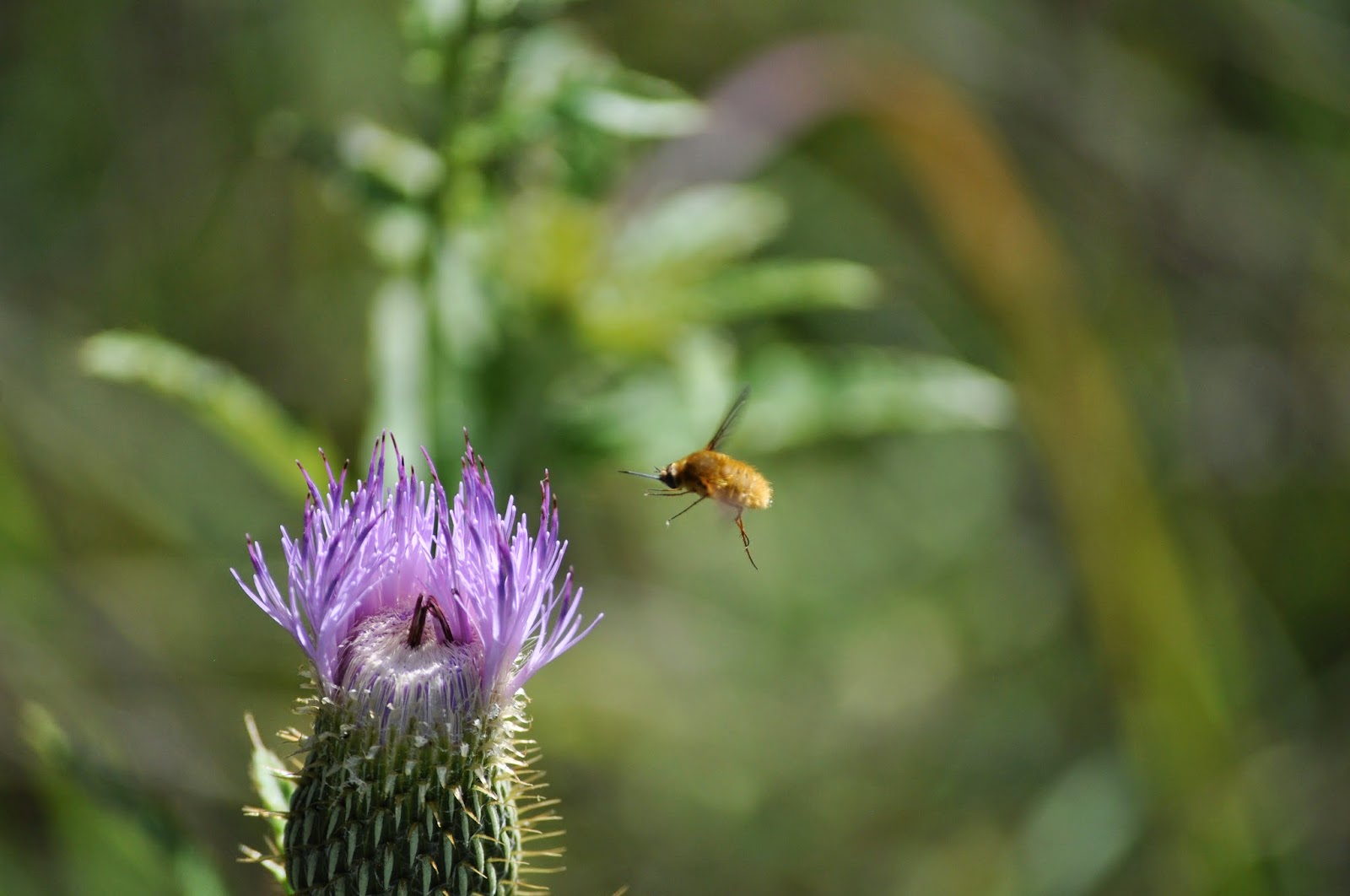 |
| Bee Fly in Kansas |
These are flies of the genus Bombylius, a large family of flies, Bombyliidae, better known as the Bee Fly. This one was hovering over a Wavy-Leaf thistle in Butler County, Kansas. Bee Flies are widely distributed in the northern latitudes and found in North America as well as Europe and Asia.
 |
| A real Honey bee |
"Imitation is flattery," and the Bee Fly flatters the bee in that they are golden-brown and furry with a back side that hints of some stripes and make a buzzing sound when flying. A Bee Fly won't bother you. The similarity is called Batesian mimicry, which simply means something harmless imitating something dangerous.
 |
| Fly Bee over a Thistle |
But unlike bees they have two wings instead of four, large eyes, skinny long legs and very short antennae, not at all like those of bees. They fly like a hummingbird and can hover in midair, move fast and maneuver with skill, changing directions in the blink of an eye. The long probe on the front of their head, call it a nose or tongue, allows them to sip nectar while hovering over the flower.


.JPG)
