Monday, September 29, 2014

Compass Plant and Silvery Checkerspot

On the Flint Hills of Kansas, there is no flower so bright and sunny in September as the Compass Plant. The name comes from the plant's tendency to face north. 


Resting for a moment on the flower is the Silvery Checkerspot (Chlosyne nycteis) butterfly.

Compass Plant and Silvery Checkerspot butterfly

Compass Plant and Silvery Checkerspot butterfly

Compass Plant and Silvery Checkerspot butterfly

Compass Plant and Silvery Checkerspot butterfly


Friday, September 19, 2014

Ths Scottish Thistle

O, the Thistle o’ Scotland was famous of auld,
Wi’ its toorie sae snod and its bristles sae bauld;
’Tis the badge o’ my country – it’s aye dear to me;
And the thocht o’ them baith brings the licht to my e’e
...


Scotland has been in the news lately, so I thought it appropriate to post an image of the national flower of Scotland, the Thistle.


I am glad, for old times sake, that Scotland will remain part of the United Kigndom.

The translation of the first stanza of the Scottish national anthum goes like this:

O, the Thistle o’ Scotland was famous of old,
Wi’ its craggy hills so trim and its bristles so bold;
’Tis the badge o’ my country – it’s yes dear to me;
And the thought o’ them both brings a light to my eye

Saturday, September 13, 2014

Indian Blanket

I came across these flowers while driving along the Kansas Scenic Highway near Marfield Green.  They are the Oklahoma state flower, the Gaillardia pulchella, commonly referred to as the Indian Blanket or Firewheel.  They grow as both a perennial and annual  plant and are a popular bedding plant because of their distinctive red and yellow color.


Indian Painted Flower


Indian Painted Flower


Indian Painted Flower

Wednesday, September 3, 2014

Kansas Buffalo Gourd

This is Labor Day weekend and I am driving along Scenic Highway 177 from Cassoday to Strong City. At Matfield Green I detour off the highway and into town. Then across Sharp's Creek to where the gravel roads lead into the Flint Hills.


Chase County gravel road


I am still in the rich bottom land. There to the left side of the road, next to a field of soy beans lie some uncut native grasses. 


Kansas Buffallo Gourd flower


Within the matted grass are several Buffalo Gourds. It is also known by the name Stinking Gourd because of the foul smell the rotting fruit gives off. The stems of the plant are trailing, in one case wrapped within a fallen gate, radiating a dozen and more feet from the center where a taproot borrows into the ground. The smooth leaves are large, pointed, and velvety.


Kansaswildflowers.org reports that the carrot-like taproot of buffalo gourd can reach 4-6 feet long and weigh more than 100 pounds. Like the native Osage Indians, I believe in the plant's mystical powers; it should not be disturbed. 

The Indians used the gourds for ceremonial rattles ad children's play toys.


A few round gourds, the size of a tennis ball, now yellow with age, but once green with light stripes like a cucumber, hang from the rails of the gate or lay on the ground. It is the end of the flowering period, but a few remain. The flowers are large and yellow like the squash blossom, and, therefore, presumably edible.


fruit of the Kansas Buffalo Gourd


Saturday, August 30, 2014

Pickerel Weed, Pontederia cordata

Pickerel Weed (Pickerelweed), Pontederia cordata, is an aquatic plant common to marshes, ponds, and lakes in the south. It grows three to four feet tall, but, you only see one or two feet, because the rest is underwater. It is native to the eastern United States and Canada. USDA Plant Profile.

It is beautifully displayed at Botanica Gardens in Wichita.

The  Pickerel Weed has towering spikes with clusters of violet-blue flowers. Each flower is small, less than half an inch wide. It has two small yellow spots on one petal.

Pickerel Weed blooms in June and continues until November. The Honey Bee and other insects pollinate the flowers. After a flower has been pollinated, it dies and a small fruit grows containing one seed each.

Pickerelweed and Honey Bee

Pickerelweed and Honey Bee

Pickerel Weed and Honey Bee


Tuesday, August 19, 2014

Solanum rostratum – Kansas Thistle

Steer clear of this one. It has yellow flowers the size of a half dollar and lobed leaves that look like those of the watermelon.


Solanum rostratum – Kansas Thistle


It is August in Kansas. Near the over grazed cattle pens and along the rocky roads you will find this low lying plant. Don't ouch this plant, the entire plant is a mass of numerous, wickedly sharp, stinging spines. Don't eat this plant, the leaves and green fruit are poisonous

This plant is a member of the Nightshade family, and poisonous alkaloids.


Its common names include: Kansas Thistle, Buffalobur Nightshade, Buffalobur, Buffalo Burr, Colorado Bur, Mexican Thistle, Texas Thistle.

Saturday, August 16, 2014

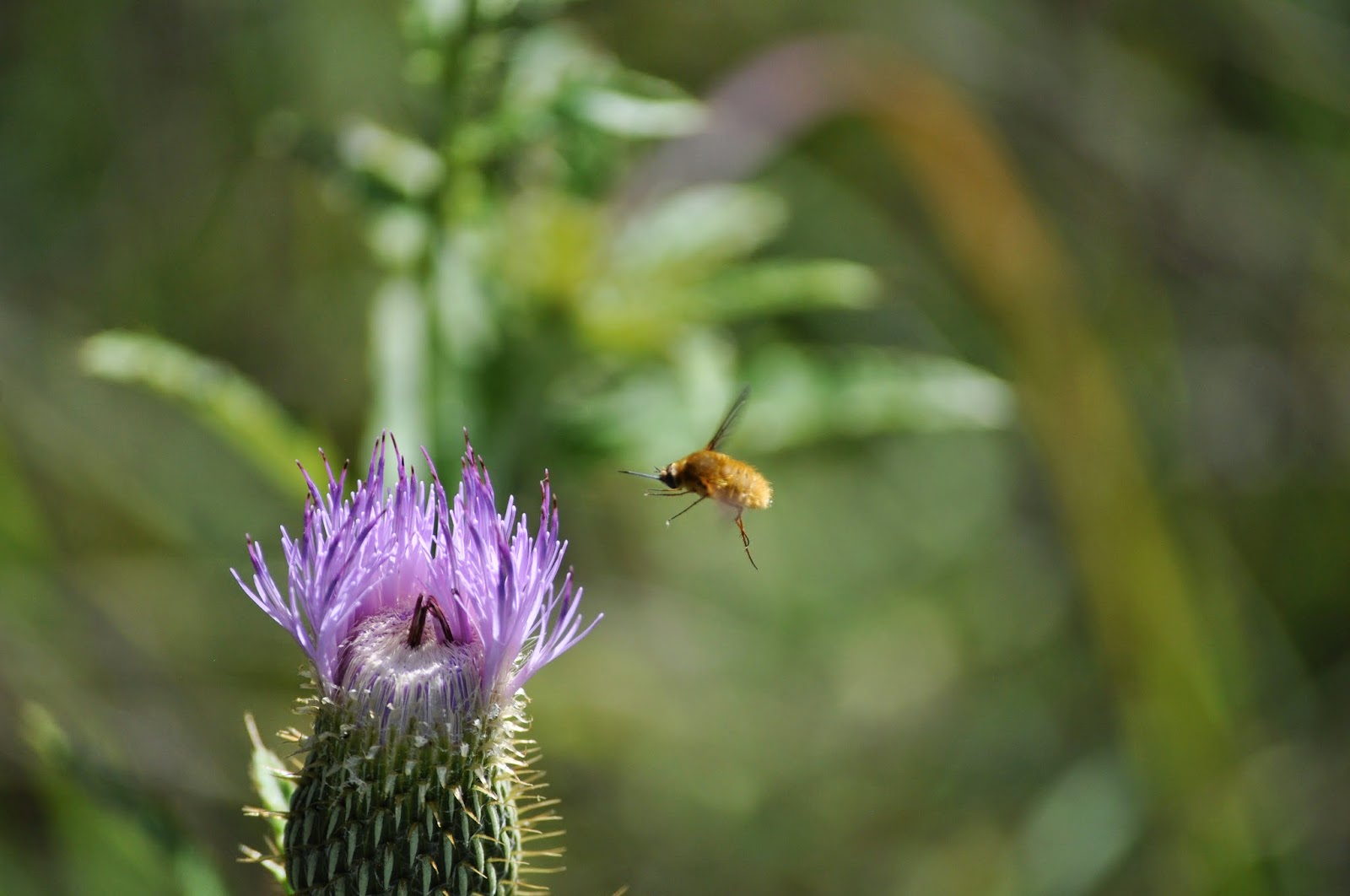
Bee Fly

To be or not to be a Bee-
Fly
It's not a Honey Bee 
Or Bumble Bee
It's a humble Bee Fly


If you were an insect, would you rather be a bee or a fly?


Bee or Fly?


If I was a lowly fly, why not be a Bee Fly?

Bee Fly in Kansas


These are flies of the genus Bombylius, a large family of flies, Bombyliidae, better known as the Bee Fly. This one was hovering over a Wavy-Leaf thistle in Butler County, Kansas. Bee Flies are widely distributed in the northern latitudes and found in North America as well as Europe and Asia.


A real Honey bee


"Imitation is flattery," and the Bee Fly flatters the bee in that they are golden-brown and furry with a back side that hints of some stripes and make a buzzing sound when flying. A Bee Fly won't bother you. The similarity is called Batesian mimicry, which simply means something harmless imitating something dangerous.


Fly Bee over a Thistle


But unlike bees they have two wings instead of four, large eyes, skinny long legs and very short antennae, not at all like those of bees. They fly like a hummingbird and can hover in midair, move fast and maneuver with skill, changing directions in the blink of an eye. The long probe on the front of their head, call it a nose or tongue, allows them to sip nectar while hovering over the flower.